You are here:

Growth Intelligence

Locate External Growth Signals And Choose Opportunities To Test

Turn observable mobile app market signals into structured growth intelligence that helps growth, marketing, product and market teams benchmark change and form testable hypotheses.

Growth signals I Competitive benchmarks I API, dataset & managed delivery

Android App Data Scraping Services AppGators

Business Decisions & Outcomes

Make External Growth Evidence Easier To Evaluate

Use observable app-store and market signals to benchmark change, identify external opportunities and decide which hypotheses deserve a test.

Custom Extraction Logic AppGators

Growth Signals

Organize observable app and market indicators that may support growth research.
Dedicated Workflows AppGators

Store Visibility Context

Review ranks, listing changes and market presence as external visibility evidence.
Dedicated Workflows AppGators

Competitive Benchmarks

Compare selected external signals across relevant competitors and markets.
Platform Specific Solutions AppGators

Opportunity Tracking

Preserve dated observations so teams can monitor how potential opportunities evolve.

Business Challenges

What Makes External Growth Intelligence Difficult To Use?

Enterprise app intelligence requires more than source access. It needs consistent structures, operating workflows and delivery that fits the business requirement.
Fragmented Sources AppGators

Limited External Benchmarks

Teams may lack consistent reference points for comparing growth-related market signals.
Changing App Signals AppGators

Fragmented Visibility Signals

Ranks, listing changes, reviews and market availability often sit in separate views.
Data Preparation AppGators

Unclear Growth Hypotheses

Observed external movement does not automatically explain why growth changed or what to test next.
Operational Continuity AppGators

Delayed Change Detection

Periodic manual research can miss when competitor or market signals begin to move.
Where App Data Comes From AppGators

Intelligence Decision Framework

Move From External Signals To Testable Growth Hypotheses

Keep the framework focused on the decision: which external changes matter, how they compare, what they might suggest, and which ideas are worth testing.
01

Define Growth Question

Clarify the market, product, visibility or acquisition question to investigate.
02

Gather Signals

Collect agreed external app and market indicators with source and date context.
03

Benchmark Changes

Compare relevant changes against competitors, markets or observation periods.
04

Form Hypotheses

Translate evidence into clearly labeled hypotheses rather than unsupported conclusions.
05

Prioritize Tests

Choose which growth ideas deserve validation through internal experiments or analysis.

Intelligence Signals & Evidence

Build Growth Views From Observable External Signals

Keep observable evidence, proxies, estimates and hypotheses clearly separated so the output supports testing rather than overstating causality.

01

Store Ranks

Observed app-store position and movement where supported by the source.
02

Listing Changes

Store-facing metadata or listing changes that may affect visibility context.
03

Review Volume Trends

Changes in visible review activity used as a contextual external indicator.
04

Ratings

Visible ratings and movement used as supporting market context.
05

Market Availability

Observed availability across markets or regions where supported.
06

Install Ranges

Visible install ranges where provided by the source, kept distinct from internal acquisition data.

Growth Signals & Hypotheses Preview

Connect Dated Market Signals To Testable Opportunities

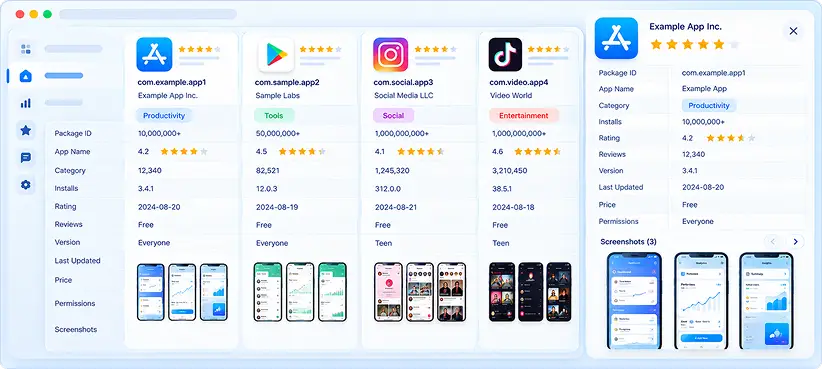
This sample demonstrates how external signals can be organized with market, observation period, comparator and an explicitly labeled hypothesis.
Important : This is a marked sample, not a live self-service product or client result.

Industries & Use Cases

Apply Growth Intelligence To Opportunity Discovery

Use structured external evidence in recurring growth planning, regional benchmarking and acquisition research workflows across relevant app-driven industries.

01

Growth Planning

Use external market and competitor signals to prioritize questions for internal growth testing.
02

Regional Benchmarking

Compare visibility, market availability and other observable signals across selected regions.
03

Acquisition Research

Use external benchmarks as context for acquisition research without presenting them as attributed campaign performance.

Delivery Options

Deliver Growth Intelligence Into The Workflow Your Team Uses

Supported delivery options, source scope and update cadence should be confirmed during requirements review before implementation.

API Delivery

For connected applications, BI systems and automated pricing workflows.

Custom Datasets

For pricing research, plan benchmarking and defined programs.

Cloud Delivery

For enterprise data platforms and downstream analytics environments.

Scheduled Feeds

For recurring external-signal and opportunity monitoring workflows.

Managed Delivery

For programs requiring ongoing collection, validation and delivery support.

Trust & Proof

Built For Repeatable Enterprise Pricing Intelligence

Use documented workflows, quality controls and clearly bounded pricing evidence to support recurring plan and monetization comparisons.
Structured Workflows AppGators

Documented Workflow

Define competitor scope, fields, comparison dimensions and evidence handling before delivery.
Quality Controls AppGators

Quality Controls

Use validation and normalization checks to keep comparisons consistent.
Competitive Intelligence Capabilities AppGators

Flexible Delivery

Support API, datasets, feeds, cloud and managed paths where confirmed.
Competitive Intelligence Capabilities AppGators

Operational
Continuity

Support recurring programs as plans and markets evolve.
Sample Deliverable AppGators

Approach & Evidence Note

Proof Should Demonstrate Evidence Handling, Not Attribution Claims

Use an approved growth-signals sample or anonymized implementation example once the supporting asset is ready.
Important : No internal conversion, retention, attributed campaign results, client logos, accuracy percentages, coverage claims or performance gains are represented in this sample.

Frequently asked questions

Pricing Intelligence Questions

Final coverage, cadence and source-specific commitments should be confirmed during content review and scoping.

How is pricing comparison scope defined?

Mobile app intelligence helps businesses monitor app performance, competitor movements, ratings, reviews, and market trends to support product decisions.

Mobile app intelligence helps businesses monitor app performance, competitor movements, ratings, reviews, and market trends to support product decisions.

Mobile app intelligence helps businesses monitor app performance, competitor movements, ratings, reviews, and market trends to support product decisions.

Mobile app intelligence helps businesses monitor app performance, competitor movements, ratings, reviews, and market trends to support product decisions.

Mobile app intelligence helps businesses monitor app performance, competitor movements, ratings, reviews, and market trends to support product decisions.

Mobile app intelligence helps businesses monitor app performance, competitor movements, ratings, reviews, and market trends to support product decisions.

Mobile app intelligence helps businesses monitor app performance, competitor movements, ratings, reviews, and market trends to support product decisions.